
How PATH 8’s data shows that CRA’s definitional advocacy is critical to improving public health outcomes and crafting better regulations in the Tobacco Industry
For more than a decade, Cigar Rights of America has made a straightforward argument to lawmakers, regulators, and the courts: premium cigars are fundamentally different from mass-market tobacco products. With the release of Wave 8 of the Population Assessment of Tobacco and Health study — the federal government’s own gold-standard survey of tobacco use — that argument has only grown stronger with more data to support it.
The PATH study, jointly conducted by the National Institutes of Health and the Food and Drug Administration, is the largest and most rigorous longitudinal survey of tobacco use in American history. Wave 8, fielded among 31,477 adults and 8,002 youth, provides the most current snapshot available of who uses tobacco, how often, and in what form. And for premium cigars, the picture it paints is remarkably consistent with every prior wave of the study: premium cigar use is occasional, confined almost entirely to older adults, and essentially nonexistent among youth.
A Product Almost Nobody Abuses — And Almost No Young Person Touches
Using the methodology developed by the National Academies of Sciences, Engineering, and Medicine in their landmark 2022 report — which classifies premium cigars based on recognized brand names supplemented by a price threshold — the estimated prevalence of current established premium cigar use among American adults in Wave 8 is approximately 0.84% of the overall population. When an additional screen is applied to exclude respondents who reported flavored products — consistent with the Mehta Definition’s requirement that a premium cigar have no characterizing flavor other than tobacco — that figure drops to 0.70%.
To put that in context, fewer than one in every one hundred American adults is an established premium cigar user. This is consistent with every prior wave of PATH data. The NASEM report found adult premium cigar prevalence of 0.6 to 0.8% from 2013 to 2018. Wave 8 shows the number has not meaningfully changed. Among adults linked across Waves 7 and 8, prevalence moved from 0.887% to 0.863% — a difference of just two-hundredths of a%age point, statistically indistinguishable from zero.
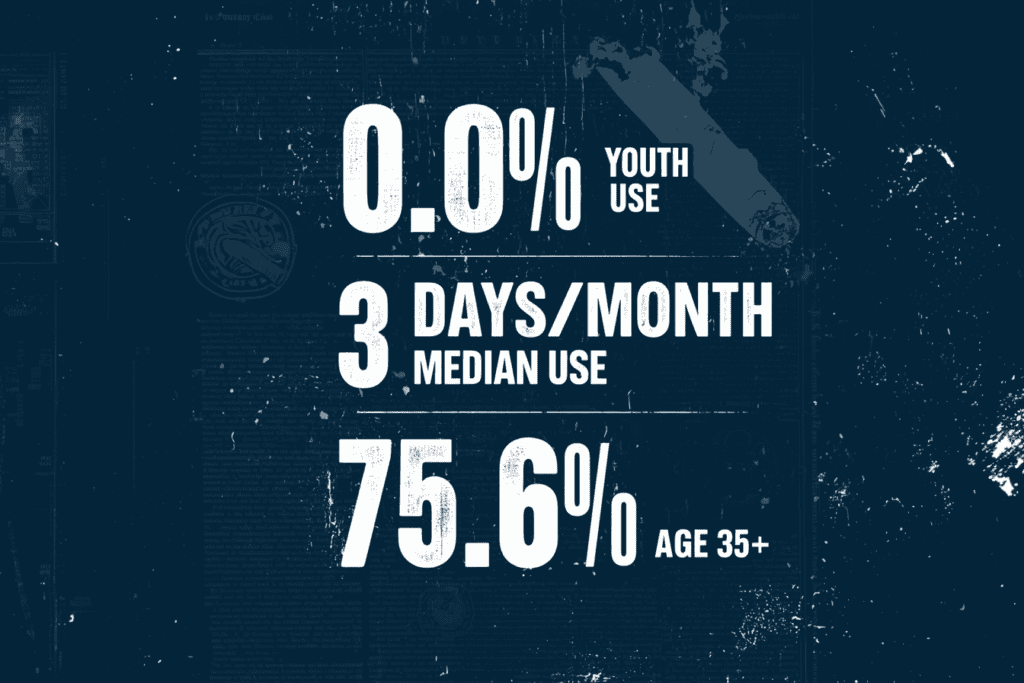
Among youth, the findings are even more decisive. Out of the entire Wave 8 youth sample, only 15 respondents reported any current “cigar” use at all. Of those 15, only four provided a recognizable brand name. Of those four, just one named a brand that actually manufactures premium cigars— Romeo y Julieta — and that respondent reported a flavored product (which are made by Romeo y Julieta), which would not meet the premium cigar definition under either the Mehta definition or the NASEM methodology – this squarely places the number of premium cigars consumed by youth at zero. This is not a new finding. It is the continuation of a trend that has been documented in every wave of PATH since the study began.
Who Actually Smokes Premium Cigars?
The demographic profile of the premium cigar consumer has been remarkably stable across a decade of federal survey data, and Wave 8 confirms it once again. Current established premium cigar users are estimated to be: 75.6% age 35 or older and 50.2% with household income of at least $100,000 – compare this with the demographic profile of cigarette smokers, which skews younger, lower-income, and less educated. Earlier PATH data showed that the median age of first premium cigar use was 24.5 years — and by Wave 3 it had risen to 29.8 years — compared to 16.7 years for cigarettes. Premium cigar users are not young people initiating a tobacco habit. They are established, affluent adults making an informed, occasional choice.
How They Use Them: Infrequent, Occasional, and Nothing Like Cigarettes
The usage patterns of premium cigar smokers are perhaps the single most important distinction between premium cigars and virtually every other tobacco product. In Wave 8, the median premium cigar user smoked on just three days in the past 30. This pattern of infrequent, non-daily use has profound health implications. The most relevant epidemiological research — published in JAMA Internal Medicine by researchers at the National Cancer Institute — found no statistically significant increase in mortality for non-daily cigar smokers. Since the overwhelming majority of premium cigar smokers — over 93% according to PATH, and nearly 97% according to the National Adult Tobacco Survey — smoke on fewer than a daily basis, the mortality data simply do not support treating premium cigars like cigarettes.
The Classification Challenge — And Why the Mehta Definition Matters
One of the most analytically significant findings in the Wave 8 analysis is the classification uncertainty inherent in the PATH data. Only 36.2% of past-30-day traditional cigar users provided a recognizable brand. Among those classified as premium cigar users under the historical proxy method, 68.4% were classified based on the $2 price threshold — not because they named a premium brand. This is not a flaw in the data. It is a reflection of the fact that the PATH study was never designed to precisely identify premium cigars. However, the significant differentiations in health-outcomes, usage patterns, and the challenges around accurately isolating the category, highlights why having a clear, product-based definition matters.
The Mehta Definition — the eight-part standard established by federal Judge Amit P. Mehta in the landmark 2023 ruling that removed premium cigars from FDA jurisdiction — defines premium cigars based on what they are: whole-leaf tobacco wrapper, 100% leaf tobacco binder, at least 50% long filler, handmade construction, no filter or non-tobacco tip, no characterizing flavor other than tobacco, no artificial additives, and a minimum weight.
This definition does not rely on price, brand recognition, or consumer self-report. It identifies a premium cigar by its physical characteristics — the same characteristics that make premium cigars fundamentally different from mass-market tobacco products in their construction, their use patterns, their consumer base, and their risk profile.
The Regulatory Implication Is Clear
Across eight waves of the federal government’s most comprehensive tobacco survey — spanning more than a decade — the data tell a consistent, unambiguous story. Premium cigars are used by a tiny fraction of the adult population. They are used infrequently and non-daily. They are not used by youth. They are purchased deliberately at specialty retailers by older, educated, affluent adults. And the epidemiological evidence shows no statistically significant mortality increase for people who smoke cigars at the frequency typical of premium cigar users.
Every new wave of data makes the case for differentiated regulation more compelling, not less. Premium cigars do not contribute meaningfully to the public health problems — youth initiation, addiction, daily habitual use — that tobacco regulation is designed to address. Treating them the same as cigarettes, e-cigarettes, or mass-market flavored cigar products is not just unnecessary. It is unsupported by the evidence.
The Mehta Definition provides lawmakers and regulators at every level of government with a clear, judicially endorsed standard for distinguishing premium cigars from the products that do warrant aggressive regulatory intervention. Wave 8 of the PATH study is the latest — and among the strongest — evidence that this distinction is not a matter of industry preference. It is a matter of scientific fact.

The Protect Cigar Freedom Plan

JOIN CIGAR RIGHTS OF AMERICA

PROTECT YOUR RIGHT TO ENJOY PREMIUM CIGARS

CONTINUE TO ENJOY YOUR FREEDOM IN PEACE TODAY AND INTO THE FUTURE